မှန်ဘာသာရပ်သည် အပြုံးလအော်အတွက် အပြုံးသောကိုယ်တိုင်တုန့်ပြန်မှု
Peter Krew ရေးသားသည်
Total Solar Eclipse, August 12, 2026: Live Video, Times, and Where to See It
Today, Wednesday, August 12, 2026, the Moon's shadow is sweeping across the top of the world. It touches down at sunrise off the coast of northern Siberia, races over eastern Greenland and western Iceland, crosses the North Atlantic, and finally reaches northern Spain in the evening light, mainland Europe's first total solar eclipse since August 1999.
If you're outside that narrow band, you can still watch the whole thing as video. Here's how, plus every time you need.
Watch the eclipse live
https://www.youtube.com/watch?v=rSvCuSQhC3w
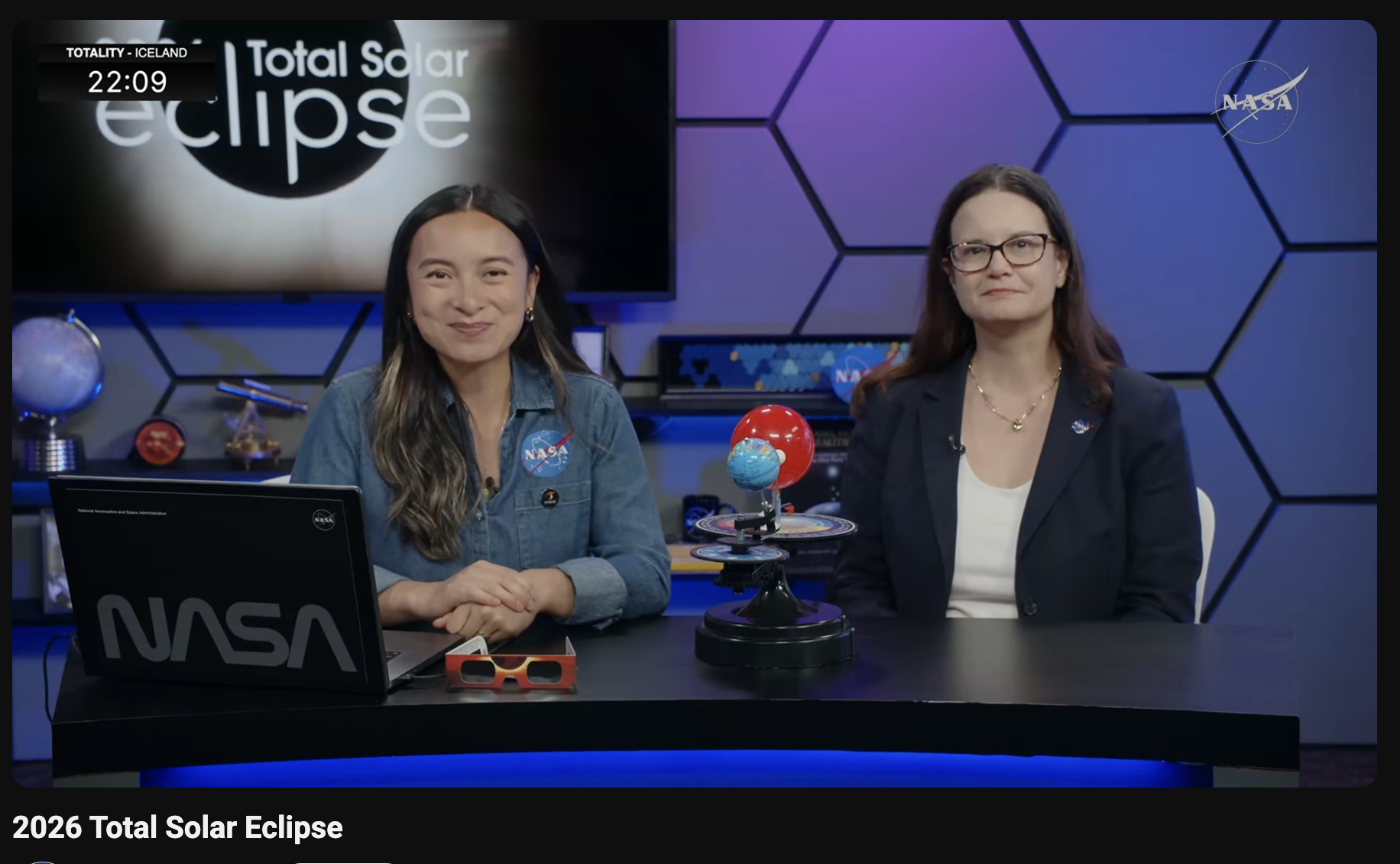
The main free broadcasts today:
- NASA, coverage begins at 17:15 UTC (1:15 p.m. EDT) with feeds from multiple points along the path and commentary from solar scientists.
- ESA, the European Space Agency is carrying its own coverage from the path in Spain.
- timeanddate.com, a hosted live stream with telescope feeds.
- The Virtual Telescope Project, telescope-only views for people who want the Sun, not the talk show.
A tip if you're watching a recording later: the moment worth scrubbing to is the last twenty seconds before totality, when the light collapses and Baily's beads flare along the edge of the Moon.
Key times (August 12, 2026)
| Event | Time (UTC) |
|---|---|
| Shadow first touches Earth (northern Russia, at sunrise) | ~15:34 |
| NASA broadcast begins | 17:15 |
| Totality reaches western Iceland | ~17:45 |
| Greatest eclipse (North Atlantic, 65.2°N 25.2°W) | 17:47 |
| Totality over Reykjavík | ~17:48 |
| Totality reaches northern Spain | ~18:27 |
| Shadow leaves Earth over the Mediterranean | ~19:00 |
Local equivalents: 19:45 CEST for Iceland's totality, 20:27-20:33 CEST for Spain, 20:46 MSK for maximum coverage in northwest Russia.
The path of totality
The band of full darkness is roughly 294 km (183 miles) wide, and at its best the total phase lasts 2 minutes 18 seconds, over open water west of Iceland. The eclipse has a magnitude of 1.0386 and belongs to Saros series 126.
Northern Russia. Totality technically begins here, on the uninhabited northeastern coast of the Taymyr Peninsula, around local midnight. Almost nobody is there to see it, and satellite records suggest August cloud cover along that coast runs near 75%.
Eastern Greenland. Scoresby Sund and the surrounding fjords, reachable mostly by expedition ship. Spectacular scenery, unreliable skies.
Western Iceland. Iceland's first total eclipse since 1954, and the first over Reykjavík in nearly six centuries. The capital sits close to the edge of the path and gets only about 59 seconds. Move west and the numbers improve fast: Stykkishólmur about 1m 28s, Ólafsvík about 2m 3s, and Látrabjarg in the Westfjords about 2m 13s, the longest totality available on land anywhere along the path.
Northern Spain. Spain's first total eclipse since 1905, and the best bet for clear sky on the entire track. Cities inside the path include A Coruña (~1m 16s), Gijón (~1m 45s), Oviedo (~1m 48s), Santander, León, Burgos, Palencia, Valladolid, Logroño, Zaragoza, Teruel, Castellón, Valencia, plus Ibiza and Palma de Mallorca. Bilbao sits right on the northern edge and gets roughly 29 seconds downtown.
One thing makes the Spanish eclipse unusual: the Sun will be very low, only a few degrees above the western horizon, minutes from setting. That means you need a clear line of sight westward, a hill, a beach, a rooftop, and it also means the corona will hang in a deep twilight sky, which photographers have been planning around for years.
A tiny northeastern corner of Portugal also catches totality before the shadow exits over the Mediterranean, just east of the Balearics.
Where the partial eclipse is visible
Far more people get a partial bite out of the Sun: most of Europe, northern Asia, North and West Africa, much of North America, and the Arctic and Atlantic. Roughly 230 million people are inside the zone where the Moon covers 90% or more of the solar disc.
For Russia and the surrounding region, the partial phases run from 18:34 to 22:58 MSK, with maximum at 20:46 MSK. Coverage reaches about 81% in Murmansk and near 80% in Arkhangelsk, St Petersburg and Kaliningrad, visible roughly an hour before sunset. Moscow, by contrast, catches only about 1%, essentially the first nick of the eclipse around 20:00-20:05 MSK.
How to look at the Sun without hurting your eyes
This part is not negotiable. During every partial phase, the Sun is dangerous to view directly, even when 95% of it is covered.
- Use certified eclipse glasses (ISO 12312-2) or a handheld solar viewer. Ordinary sunglasses, any number of them stacked, do nothing.
- Cameras, binoculars and telescopes need a proper solar filter on the front. Pointing an unfiltered lens at the Sun will ruin the sensor and can injure you instantly through an eyepiece.
- Totality is the one exception. Once the Sun's disc is completely covered, you can and should look with bare eyes. Put the glasses back on the instant the first sliver of light returns.
- No glasses? Make a pinhole projector: a small hole in card, projecting the Sun's crescent image onto a white surface. Tree shade does the same thing naturally, look at the ground under a leafy tree during the partial phase and you'll see hundreds of small crescents.
A rare double bill: the eclipse and the Perseids
August 12 is also the peak of the Perseid meteor shower, with up to about 100 meteors an hour in dark skies overnight. NASA scientists have pointed out that a bright Perseid could conceivably streak through the darkened sky during totality itself. Realistically, the two are best treated as separate events: the eclipse in the evening, the meteors after full darkness.
What's next
- August 28, 2026, partial lunar eclipse
- February 6, 2027, annular solar eclipse
- August 2, 2027, total solar eclipse across southern Spain, North Africa, Saudi Arabia and Yemen, with an exceptionally long total phase of about 6 minutes 22 seconds near Luxor, Egypt
- January 26, 2028, annular eclipse touching South America, Portugal and Spain
- March 30, 2033, the next total eclipse visible from Russian territory, over Chukotka
If you missed today's, the 2027 event is the one to plan around. Six minutes of totality under a near-guaranteed desert sky is about as good as this phenomenon gets.
Sources: NASA Science · ESA · timeanddate · National Solar Observatory · Eclipsophile · Space Research Institute (IKI RAS)