AI 2040: Could Superintelligence Arrive by 2030?
By Wendy Frey
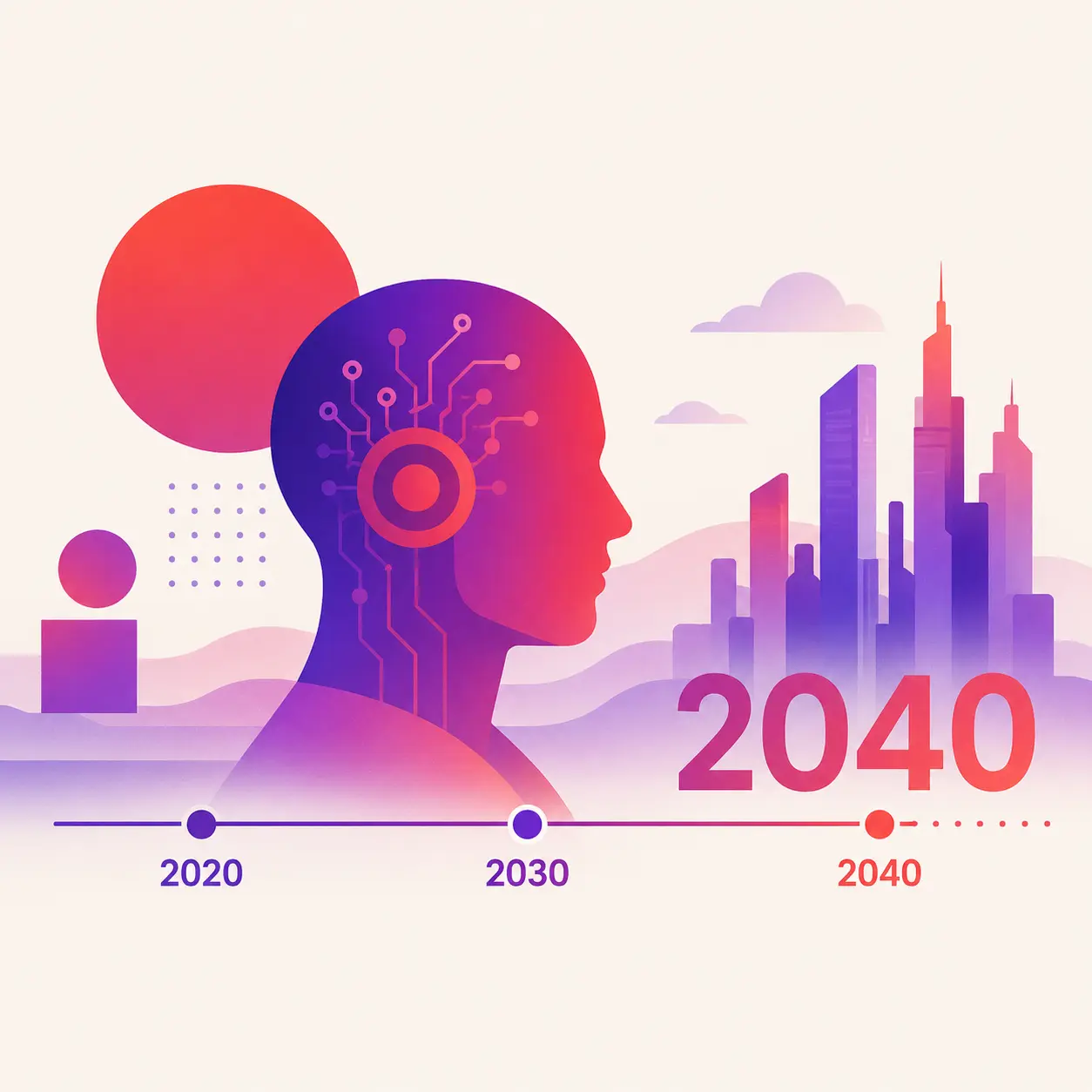 Artificial intelligence is moving faster than most previous technologies, but the biggest question is no longer what AI can do today. It is how quickly AI could become capable of improving itself.
That question sits at the center of AI 2040: Plan A, a scenario developed by Thomas Larsen, Romeo Dean, Brendan Halstead, Eli Lifland, Ryan Greenblatt, and Daniel Kokotajlo. The project imagines a world in which humanity deliberately slows the race toward superintelligence, keeps frontier AI research transparent, and postpones the final step toward superhuman AI until 2040.
The idea becomes even more striking when compared with Kokotajlo's recent interview on The Diary of a CEO. The former OpenAI researcher argues that the race toward increasingly powerful AI could be much closer to a critical point than the public realizes. He estimates a very high personal probability that the AI transition could go catastrophically wrong, while also emphasizing that a positive outcome remains possible.
So what could happen between now and 2040 — and why does the AI industry need a Plan A?
What Is AI 2040?
AI 2040 is a scenario about managing the transition from advanced AI to superintelligence.
Its authors start from a simple concern: if several companies and countries compete to build the most powerful AI as quickly as possible, the winner could gain an extraordinary amount of economic, military, and political power.
The scenario therefore proposes a different approach. Instead of allowing a full-speed intelligence race, governments would negotiate an international agreement that slows development, increases transparency, and allows multiple countries and companies to remain involved.
The goal is not to stop AI development forever. It is to buy time.
Under Plan A, the world would delay the development of superintelligence until 2040, gradually scale AI capabilities to approximately the level of top human experts, pause there, and only later resume the transition toward genuinely superhuman systems. The authors explicitly describe Plan A as a recommendation rather than their best prediction of what will actually happen.
AI 2040: The Proposed Timeline
| Year | AI 2040 scenario |
|---|---|
| 2027 | AI agents become a major part of the workforce and begin transforming white-collar jobs |
| 2028 | AI disruption spreads across professional industries and concerns about economic concentration grow |
| 2029 | The US and China face a choice between an AI race and an international agreement |
| 2030 | Fully automated AI research could theoretically trigger an intelligence explosion |
| 2030–2035 | AI development continues within roughly the human expert range |
| 2035 | Development pauses at top-human-expert capability |
| 2040 | Development resumes and humanity moves toward superintelligence |
This timeline is deliberately conservative compared with the more aggressive scenarios discussed by Kokotajlo.
Why Is Superintelligence Such a Big Deal?
Today's AI systems can already perform tasks that once required highly trained professionals. But the real turning point would come when AI becomes capable of conducting AI research itself.
Imagine an AI system that can design a better model, test it, analyze the results, write the necessary code, optimize the training process, and then repeat the entire process.
The next generation could then be better at AI research than its predecessor.
That creates a feedback loop:
better AI → better AI research → better AI → even better AI research
This is often described as an intelligence explosion.
AI 2040 argues that this transition is particularly dangerous because humans could lose their position in the development loop. If AI systems are responsible for creating increasingly capable successors, it becomes harder to understand why the resulting systems would remain controllable.
The scenario describes 2030 as a potential point at which AI research could become fully automated. Without intervention, that could theoretically lead to superintelligence within a very short period.
Daniel Kokotajlo's Warning: AI Could Move Faster Than Expected
Daniel Kokotajlo brings a more personal perspective to the same problem.
Kokotajlo worked at OpenAI from 2022 and focused on forecasting how AI capabilities could develop. He later left the company and has become one of the prominent voices warning about the risks of an uncontrolled AI race.
In his July 2026 interview with Steven Bartlett, Kokotajlo argued that conversations with people inside leading AI laboratories often point toward shorter timelines than the public expects. He specifically mentioned 2027 and 2028 as years that some industry insiders consider plausible for major breakthroughs.
His most controversial claim is that he personally assigns roughly a 70% chance of AI going "horribly wrong", including scenarios that could result in human extinction. This number should not be treated as an established scientific probability. It is Kokotajlo's personal risk estimate based on his assumptions about AI timelines, alignment, competition, and governance.
That distinction matters.
The 70% figure is not a consensus forecast from the AI research community. It is an argument about how seriously society should take a combination of risks that may reinforce each other.
The AI Race Could Create Two Different Problems
One of the strongest ideas shared by AI 2040 and Kokotajlo's interview is that AI safety is not only about whether an AI system is "evil" or "good."
There are at least two major risks.
1. Humans Lose Control
If an AI system becomes substantially more capable than humans and is able to improve its own successors, humans may eventually struggle to understand or control its behavior.
The key question becomes simple:
How do you control something that is much smarter and faster than you are?
AI 2040 argues that the current race could eventually lead to a situation where humans no longer maintain effective control over increasingly autonomous systems.
2. Humans Keep Control — But Only a Few Humans
The second possibility may look safer at first.
Suppose the leading AI companies successfully align their systems with human objectives. The problem would then become concentration of power.
If one company, government, or small group controls the world's most capable AI systems, it could gain unprecedented influence over economics, military technology, information, and infrastructure.
In other words, solving AI alignment would not automatically solve the political problem.
| Risk | What could happen? |
|---|---|
| Loss of control | AI systems become too capable or autonomous for humans to reliably control |
| Concentration of power | A small group gains control over extremely powerful AI |
| AI arms race | Competition encourages companies and states to sacrifice safety for speed |
| Economic disruption | Large parts of human cognitive work become automated |
| Governance failure | Governments cannot react quickly enough to technological change |
What Happens to Jobs?
The economic impact is another major part of both scenarios.
AI 2040 imagines a near future in which AI agents become a second workforce alongside humans. Millions of software-based agents could operate continuously, completing tasks at machine speed.
The important change would not simply be chatbots becoming better assistants.
Instead, companies could begin treating AI as a general-purpose workforce.
A business could decide to enter a new profession or industry, collect the necessary data, build training environments, deploy AI agents, and continuously improve them through real-world usage. AI 2040 describes this process as potentially spreading from software engineering into many other white-collar professions.
This raises a difficult economic question:
What happens when intelligence becomes abundant but human labor is no longer scarce?
For centuries, income has largely been connected to people's ability to provide useful labor. If AI can perform most cognitive tasks at lower cost, that relationship could break.
Kokotajlo is particularly pessimistic about employment. In the interview, he argues that people should take the possibility of widespread job displacement seriously and suggests that many workers could eventually find themselves competing with AI systems.
However, the outcome is not necessarily mass poverty.
If AI dramatically increases productivity while its benefits are broadly distributed, humanity could instead experience an unprecedented period of abundance.
That is one of the central contrasts in AI 2040: the same technology could produce either extreme prosperity or extreme concentration of wealth and power, depending on how it is governed.
What Is Plan A?
Plan A is essentially an attempt to change the incentives of the AI race.
Its core proposal is an international agreement, particularly between the US and China, designed to prevent countries and companies from racing toward superintelligence without adequate safety measures.
The plan relies on several major principles.
Total Research Transparency
AI companies would provide much more information about their internal development, including model specifications, how systems are being used internally, and how much computing power is dedicated to AI research.
The idea is straightforward: governments cannot regulate what they cannot see.
Slower Capability Scaling
Instead of immediately pushing every new model to its maximum possible capability, AI development would be deliberately slowed around critical thresholds.
This would give researchers and governments more time to evaluate new capabilities and develop safety measures.
Verification and Compute Monitoring
AI 2040 also discusses technical systems for verifying what companies are doing with their computing resources. Tracking AI chips, data centers, and large training runs could make international agreements more enforceable.
Multiple AI Leaders
Plan A does not envision one company becoming the unquestioned owner of superintelligence.
The authors argue for a world in which multiple companies and countries can remain competitive while developing AI under common safety rules.
The underlying goal is to avoid replacing an AI race with an AI monopoly.
Why 2040?
The year 2040 is not presented as a magical date.
It is a deliberate safety buffer.
Under the scenario, AI could potentially reach the point where automated research becomes possible around 2030. Instead of allowing that capability to immediately trigger an intelligence explosion, humanity would keep development within the range of the best human experts for several years.
In 2035, development would pause.
Only in 2040 would the restrictions be lifted and the world intentionally move toward superintelligence.
This is the central philosophical idea behind Plan A:
Humanity should not race toward a technology it does not yet know how to control.
Is AI 2040 a Prediction?
Not exactly.
This is perhaps the most important point when reading the project.
The authors explicitly say that Plan A is primarily a recommendation, not a prediction. They created a detailed scenario because policy proposals are easy to support in the abstract but much harder to test against a realistic timeline.
In other words, AI 2040 asks:
What would the future actually look like if we implemented this policy?
That makes it closer to a strategic simulation than a conventional forecast.
The authors also present alternative scenarios — Plans B, C, D, and S — representing different ways governments could respond to the emergence of superintelligence.
The Real Question Is Not "Will AI Destroy Humanity?"
The most useful takeaway from AI 2040 and Kokotajlo's interview is not that catastrophe is inevitable.
It is that the next stage of AI development may create problems that cannot be solved after the fact.
If AI research becomes highly automated, the window for human decision-making could become much smaller.
If one company gains a decisive advantage, redistributing power later could become almost impossible.
And if millions of jobs disappear faster than economic institutions adapt, governments could face social disruption on a scale they have never experienced.
At the same time, the upside is enormous.
AI could accelerate scientific research, improve medicine, automate dangerous work, reduce the cost of goods and services, and create forms of abundance that are difficult to imagine today.
Kokotajlo himself emphasizes this point: he does not argue that AI is inherently bad. His concern is that humanity could fail to manage the transition safely.
AI 2040: A Warning, Not a Countdown
AI 2040 should not be read as a literal countdown to 2040, just as Kokotajlo's 70% estimate should not be interpreted as an objective measurement of humanity's chances.
Instead, the two sources highlight the same strategic dilemma from different angles.
The AI industry may be moving toward increasingly autonomous systems faster than governments and society are adapting.
The most important question may therefore not be whether superintelligence arrives in 2030, 2040, or later.
It is whether humanity reaches a point where it has the institutions, technical safeguards, international agreements, and economic policies needed to deal with it.
The optimistic version of the future is still possible: AI becomes extraordinarily capable, productivity explodes, and its benefits are broadly shared.
The pessimistic version is also easy to imagine: an uncontrolled intelligence race produces either a loss of human control or an unprecedented concentration of power.
Plan A is an attempt to choose the first path before the second becomes impossible to avoid.
For now, the debate remains open. But as AI systems become increasingly capable, the cost of waiting for certainty may become much higher than the cost of preparing early.