AI drug discovery 2026: how generative chemistry startups are turning models into molecules
By Wendy Frey
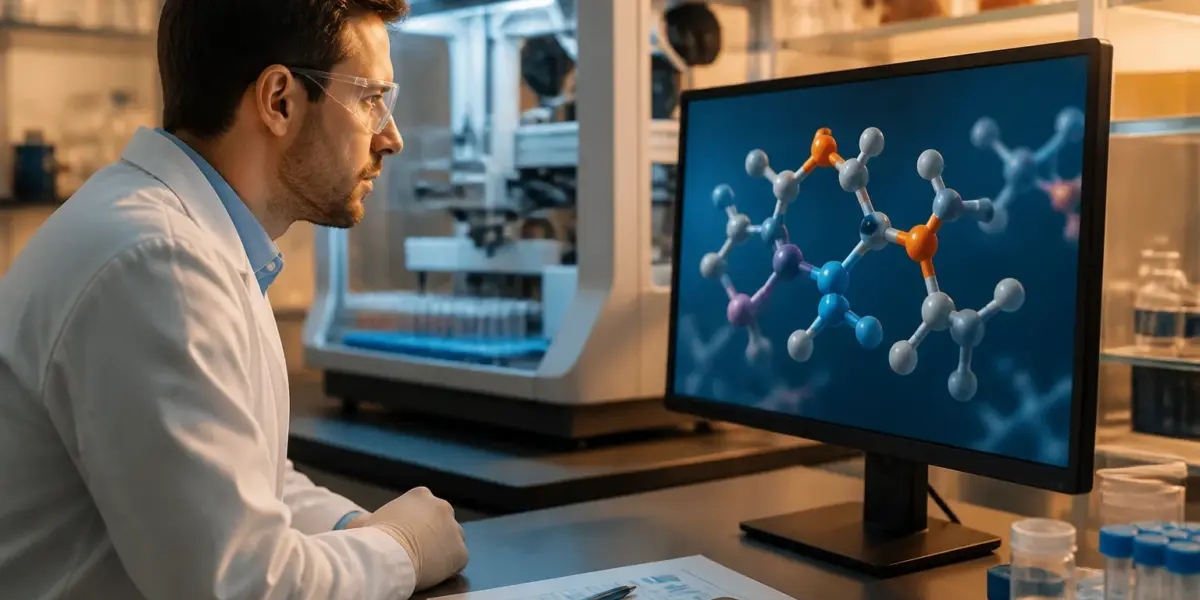 Drug discovery is no longer purely a chemistry challenge—it's increasingly becoming a machine learning problem.
In 2026, generative AI systems do far more than predict biological outcomes. They actively design entirely new molecules, optimizing properties such as binding affinity, safety, and manufacturability before a single compound is synthesized in a laboratory.
This shift is often described as "models turning into molecules." A more accurate description, however, is that AI has become a proposal engine for chemistry, while wet laboratories serve as the validation layer.
The impact is already visible. Pharmaceutical companies are signing multi-billion-dollar partnerships with AI-first biotech startups, and portions of modern drug pipelines are now being generated in silico before entering physical testing.
What "Generative Chemistry" Actually Means
Generative chemistry refers to AI systems capable of creating entirely new molecular structures rather than simply analyzing existing compounds.
These models are trained using data such as:
- Known drug molecules
- Protein structures
- Biochemical interaction datasets
- Experimental assay results
Rather than manually exploring chemical space, these systems learn to navigate and generate new molecular candidates algorithmically.
Core Capabilities of Modern Generative Drug Platforms
Modern AI drug discovery platforms typically support:
- De novo molecule generation
- Structure-based molecular optimization
- Multi-objective optimization for toxicity, solubility, binding affinity, and other properties
- Large-scale virtual screening
- Iterative design–test cycles informed by laboratory feedback
Why Pharma Is Investing Heavily in AI
Traditional drug discovery is slow, expensive, and highly uncertain.
Bringing a single drug to market often requires 10–15 years of research and billions of dollars, with a high probability of failure during clinical trials.
Generative AI proposes a different approach.
Instead of experimentally testing millions of compounds, researchers can generate a much smaller set of highly promising candidates before entering the laboratory.
Traditional vs. AI-Driven Drug Discovery
| Stage | Traditional Approach | Generative AI Approach |
|---|---|---|
| Target discovery | Experimental research and literature review | ML-driven omics analysis and prediction models |
| Molecule design | Manual medicinal chemistry iterations | AI-generated molecular candidates |
| Screening | Large physical compound libraries | Large-scale virtual screening |
| Optimization | Repeated laboratory experiments | Multi-objective AI optimization |
| Time to candidate | Years | Months—or even weeks in some cases |
The biggest advantage isn't simply speed.
It's the ability to reduce uncertainty much earlier in the discovery pipeline.
Inside Modern Generative Chemistry Platforms
Most AI drug discovery platforms in 2026 are multi-component systems rather than standalone models.
A typical architecture includes:
- A generative model that proposes new molecules
- A predictive model that estimates molecular properties
- Docking and physics-based simulation layers
- Filtering and ranking systems
- Continuous feedback from wet-lab experiments
This hybrid architecture is essential because purely generative models alone cannot reliably satisfy the complex constraints imposed by chemistry and biology.
Where Generative AI Delivers the Most Value
Despite the excitement surrounding the technology, AI is not replacing medicinal chemists.
Instead, it accelerates stages of drug discovery dominated by search and optimization.
Strong Use Cases
Current strengths include:
- Antibody design
- Protein-ligand interaction modeling
- Early-stage hit discovery
- Biomarker identification
- Constraint-aware lead optimization
These applications allow researchers to explore areas of chemical space that would be virtually impossible to investigate manually.
Where Generative AI Still Struggles
Chemistry involves much more than recognizing patterns.
Successful drug design must satisfy constraints imposed by physics, synthesis feasibility, and complex biological systems.
Common limitations include:
- Generating molecules that appear valid but cannot actually be synthesized
- Missing rare biochemical edge cases
- Overfitting to available training datasets
- Inaccurate predictions of real-world molecular binding
- Limited transfer from simulation results to laboratory experiments
For these reasons, most production drug discovery platforms continue to rely on hybrid human–AI workflows.
The 2026 Ecosystem: AI Startups and Pharma Converge
The industry is rapidly evolving into partnerships between AI-native startups and established pharmaceutical companies.
Typical Roles Within the Ecosystem
| Participant | Primary Role | Value Added |
|---|---|---|
| AI startups | Molecular generation platforms | Speed and exploration of chemical space |
| Pharmaceutical companies | Clinical development and trials | Validation and regulatory execution |
| Research laboratories | Experimental testing | Ground-truth biological data |
| Cloud and compute providers | Infrastructure | Scalable training and simulation resources |
This division of responsibilities reflects an important principle:
AI generates hypotheses, while biology determines whether they are correct.
Why This Trend Is Accelerating
Several technological advances are reinforcing one another:
- Improved protein structure prediction systems (such as AlphaFold-class models)
- More capable diffusion models for molecular generation
- Larger biochemical datasets from pharmaceutical research
- Faster GPU clusters and high-performance computing infrastructure
- Integration of large language models into scientific research workflows
Together, these developments create a continuous feedback loop in which AI systems improve through ongoing experimental validation.
Final Takeaway
Generative AI is not replacing drug discovery.
Instead, it is compressing much of the early discovery process into computational workflows.
The industry's transformation is fundamentally structural:
- Chemistry becomes a design space.
- Biology becomes the validation system.
- AI becomes the exploration engine connecting the two.
The organizations leading this transformation are not necessarily those with the most advanced standalone model.
They are the ones capable of building closed-loop platforms that seamlessly connect molecular generation, property prediction, laboratory validation, and continuous learning.