- What “generative chemistry” actually means
- Why pharma is suddenly betting on AI
- Inside modern generative chemistry systems
- Where generative AI works best today
- Where it still struggles
- The ecosystem in 2026: startups + pharma convergence
- Why this trend is accelerating now
- Final takeaway
Drug discovery is no longer just a chemistry problem — it’s increasingly becoming a machine learning problem.
In 2026, generative AI systems are not just predicting biological outcomes anymore. They are actively designing molecules from scratch, optimizing for binding affinity, safety, and even manufacturability before anything is synthesized in a lab.
This shift is often described as “models turning into molecules” — but in reality, it’s more accurate to say that AI is now becoming a proposal engine for chemistry, while wet labs act as verification systems.
The impact is already visible: pharma companies are signing billion-dollar deals with AI-first biotech startups, and drug pipelines are being partially generated in silico.
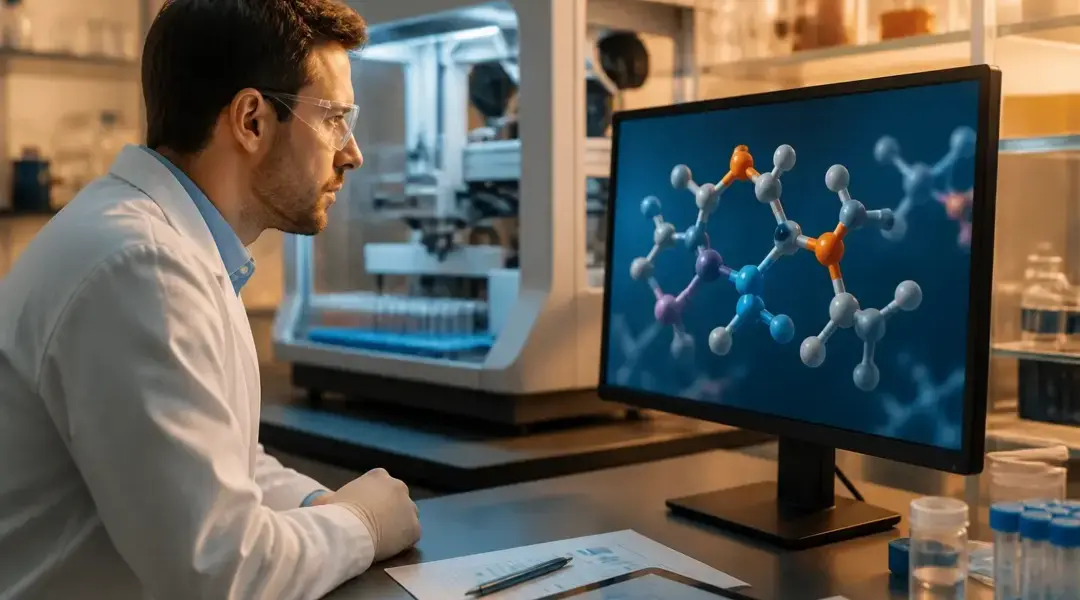
What “generative chemistry” actually means
Generative chemistry refers to AI systems that can create new molecular structures instead of just analyzing existing ones.
These models are trained on:
- known drug molecules
- protein structures
- biochemical interaction data
- experimental assay results
Instead of searching chemical space manually, they learn to navigate and generate it algorithmically.
Core capabilities of modern generative drug platforms
- de novo molecule generation
- structure-based optimization
- multi-objective property tuning (toxicity, solubility, affinity)
- virtual screening at massive scale
- iterative design-test loops with lab feedback
Why pharma is suddenly betting on AI
Traditional drug discovery is slow, expensive, and uncertain.
A single drug can take 10–15 years and billions of dollars to reach the market, with extremely high failure rates in clinical trials.
Generative AI promises a different model:
instead of testing millions of compounds in labs, you generate fewer but more promising candidates upfront.
Traditional vs AI-driven drug discovery
| Stage | Traditional approach | Generative AI approach |
| Target discovery | Experimental + literature research | ML-driven omics + prediction models |
| Molecule design | Manual chemistry iteration | AI-generated molecular candidates |
| Screening | Large physical compound libraries | Virtual screening at scale |
| Optimization | Iterative lab testing | Multi-objective AI refinement |
| Time to candidate | Years | Months or weeks (in some cases) |
The key difference is not just speed — it’s how early uncertainty is reduced in the pipeline.
Inside modern generative chemistry systems
Most AI drug discovery platforms in 2026 are not single models — they are multi-component systems.
A typical pipeline includes:
- generative model (creates molecules)
- predictive model (estimates properties)
- docking / physics-based simulation layer
- filtering and ranking system
- feedback loop from lab experiments
This hybrid design is important because pure generative models alone are not reliable enough for chemistry constraints.
Where generative AI works best today
Despite the hype, AI is not replacing chemists — it is accelerating specific parts of the workflow where search and optimization dominate.
Strong use cases
- antibody design
- protein-ligand interaction modeling
- early-stage hit discovery
- biomarker identification
- lead optimization under constraints
In these areas, AI helps explore chemical space that would be impossible to scan manually.
Where it still struggles
The biggest limitation is that chemistry is not just a pattern recognition problem — it is constrained by physics, synthesis feasibility, and biology.
Common issues include:
- generating molecules that look valid but are not synthesizable
- missing rare biochemical edge cases
- overfitting to training datasets
- inaccurate real-world binding predictions
- weak transfer from simulation to wet-lab results
This is why most serious platforms still rely on hybrid human + AI workflows.
The ecosystem in 2026: startups + pharma convergence
The space is rapidly consolidating into partnerships between AI-native startups and large pharmaceutical companies.
Example ecosystem dynamics
| Player type | Role in ecosystem | Value added |
| AI startups | Molecule generation platforms | Speed + exploration of chemical space |
| Pharma companies | Clinical development + trials | Validation + regulatory execution |
| Research labs | Experimental feedback | Ground truth data |
| Cloud/compute providers | Infrastructure | Scalable training + simulation |
This division of labor is important: AI generates hypotheses, but biology validates reality.
Why this trend is accelerating now
Several technological shifts are converging:
- better protein structure prediction (e.g., AlphaFold-level systems)
- improved diffusion models for molecular generation
- larger biochemical datasets from pharma pipelines
- faster GPU/cluster infrastructure
- integration of LLMs into scientific workflows
Together, these enable a loop where AI systems can continuously improve based on experimental feedback.
Final takeaway
Generative AI is not “replacing drug discovery” — it is compressing the early stages of it into a computational system.
The real transformation is structural:
- chemistry becomes a design space
- biology becomes a validation system
- AI becomes the exploration engine between them
The companies winning in this space are not those with the best single model, but those that can build closed-loop systems connecting generation, prediction, and real-world feedback.