Preparing an LLM security playbook: threat modeling, red teaming, and recovery
By Wendy Frey
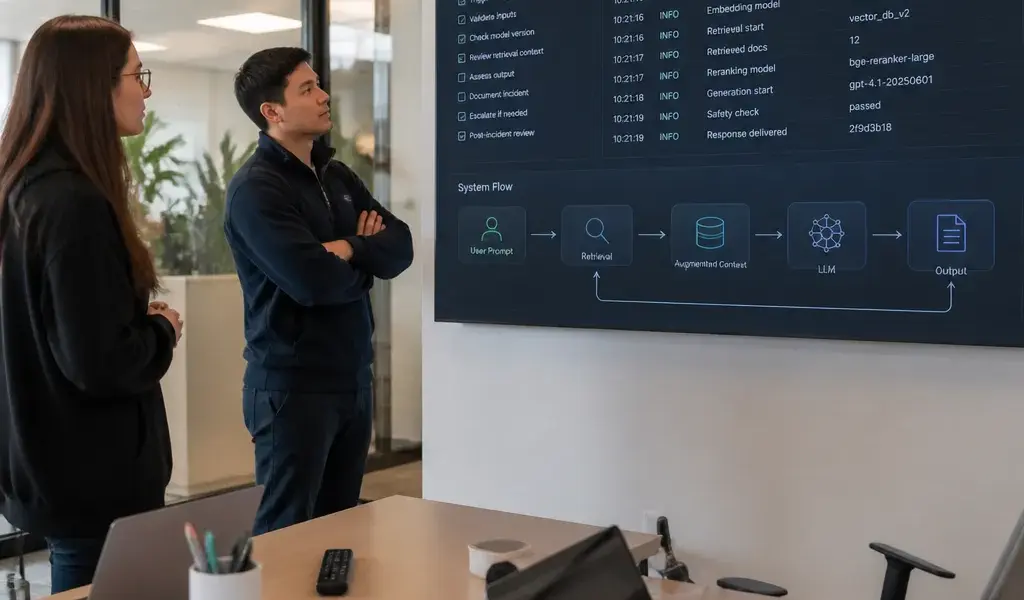 As large language models become deeply integrated into production systems, security is no longer just a theoretical concern—it becomes an operational necessity. Modern LLMs are no longer standalone models. They serve as interfaces to enterprise data, external tools, APIs, and even business-critical workflows.
That also means they introduce an entirely new class of security risks, including prompt injection, data leakage, model manipulation, and unsafe tool execution.
An LLM security playbook is essentially a structured framework for answering one fundamental question:
How can this system be compromised, and how do we ensure it remains safe even when something goes wrong?
What an LLM Security Playbook Covers
A comprehensive security playbook is not a single document but a collection of processes that combine security planning during development with continuous protection after deployment.
A typical playbook includes:
- Threat modeling (identifying what could go wrong)
- Red teaming (testing how the system can be exploited)
- Mitigation strategies (reducing or preventing vulnerabilities)
- Recovery procedures (responding effectively after incidents)
Rather than focusing solely on model accuracy, the objective is to ensure robust behavior under adversarial conditions.
Step 1: Threat Modeling for LLM Systems
Threat modeling is the foundation of any LLM security strategy. The goal is to identify potential vulnerabilities before the system reaches production.
Unlike traditional software, LLM applications interact through natural language, making the attack surface significantly broader and less predictable.
Common Threat Categories
- Prompt injection (direct or indirect)
- Data exfiltration through prompts, context, or connected tools
- Malicious tool or API execution
- Hallucinations with real-world consequences
- Jailbreak attempts that bypass safety mechanisms
Threat Model Overview
| Threat Type | Description | Typical Impact |
|---|---|---|
| Prompt injection | User manipulates instructions inside prompts | Unsafe behavior or instruction override |
| Data leakage | Sensitive information exposed through context or retrieval | Privacy violations |
| Tool abuse | Model executes unintended actions through connected tools | External system damage |
| Jailbreaking | Circumventing alignment and safety mechanisms | Policy violations |
| Context poisoning | Malicious information inserted into memory or RAG systems | Long-term system corruption |
The key insight is simple:
In LLM systems, inputs are not just data—they are also instructions.
Step 2: Red Teaming LLM Applications
Red teaming involves deliberately attempting to break an LLM system before attackers do.
This process is especially important because many failures only appear under carefully engineered prompts or complex multi-step interactions.
What Red Teaming Typically Tests
- Resistance to jailbreak attempts
- Tool misuse scenarios
- Hidden instruction conflicts
- Multi-turn prompt manipulation
- Retrieval-augmented prompt injection attacks
Typical Red Teaming Workflow
| Stage | Activity | Goal |
|---|---|---|
| Planning | Define the attack surface | Understand system boundaries |
| Attack Design | Create adversarial prompts | Simulate realistic attacks |
| Execution | Test the system | Identify failure points |
| Analysis | Categorize vulnerabilities | Prioritize fixes |
| Retesting | Verify mitigations | Ensure security improvements work |
A useful mindset is:
If a user can imagine an attack, eventually someone will try it.
Step 3: Mitigation Strategies
Once vulnerabilities have been identified, the next step is building multiple layers of defense.
There is no single security mechanism capable of protecting an LLM application. Effective security comes from overlapping safeguards.
Common mitigation techniques include:
- Prompt sanitization and filtering
- Strict permission controls for external tools
- Retrieval filtering and grounding validation
- Output validation layers
- Isolation of system prompts
- Rate limiting and anomaly detection
The guiding principle is that the model should never become the sole decision-maker for critical actions.
Step 4: Recovery and Incident Response
Even well-designed AI systems can fail in unpredictable ways.
That is why incident recovery should be planned before deployment rather than after an incident occurs.
Recovery procedures typically focus on:
- Isolating compromised components
- Rolling back unsafe prompts or configurations
- Temporarily disabling vulnerable tools
- Replaying logs to reconstruct attack paths
- Updating safety rules and filtering mechanisms
Incident Response Structure
| Phase | Action | Outcome |
|---|---|---|
| Detection | Identify abnormal behavior | Early warning |
| Containment | Limit system exposure | Prevent further damage |
| Investigation | Analyze prompts and logs | Root cause identification |
| Mitigation | Patch vulnerabilities | Remove exploit paths |
| Recovery | Restore the system safely | Return to production |
During security incidents, speed often matters more than perfection. LLM-related failures can escalate quickly because they directly affect live user interactions.
Building a Complete LLM Security Lifecycle
Mature organizations treat security as an ongoing process rather than a one-time checklist.
A typical lifecycle follows a continuous loop:
Design → Test → Attack → Fix → Monitor → Repeat
This continuous cycle allows security practices to evolve alongside new attack techniques emerging within the LLM ecosystem.
Lifecycle Overview
| Stage | Primary Focus | Deliverable |
|---|---|---|
| Design | Threat modeling | Risk assessment |
| Testing | Red teaming | Vulnerability report |
| Deployment | Security controls | Protected production system |
| Monitoring | Runtime observation | Alerts and operational logs |
| Response | Incident management | Recovery procedures |
Final Takeaway
LLM security is not about eliminating every possible risk—that isn't realistic for systems that interact through natural language.
Instead, the goal is to:
- Understand how the system could be attacked.
- Continuously simulate realistic attack scenarios.
- Build layered defenses that minimize the impact of successful attacks.
- Recover quickly and safely when failures occur.
A well-designed security playbook doesn't simply protect the language model—it protects the entire ecosystem surrounding it.