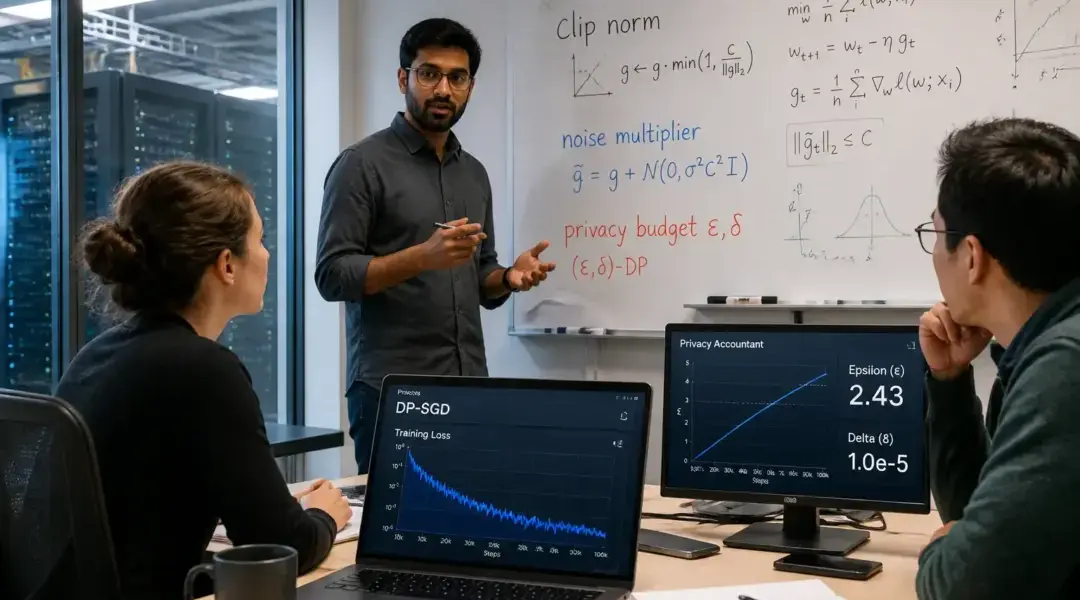
- DP-SGD: The Workhorse of Differential Privacy
- Secure Aggregation vs Differential Privacy
- DP-SAM: Improving Accuracy Under Privacy Constraints
- Comparison: DP-SGD vs DP-SAM
- Practical Workflow for DP Training
- Final Takeaway
Differential Privacy (DP) has become a core building block in modern machine learning systems where user data protection is not optional, but a requirement. Instead of relying on trust, DP provides a mathematical guarantee that individual data points do not significantly influence the final model.
In simpler terms, even if one user’s data is removed or changed, the output of the model should remain almost the same.
This idea is usually formalized through two parameters:
- ε (epsilon) — how much information about an individual can leak (lower is better)
- δ (delta) — a small probability that the guarantee might not hold perfectly
The challenge in real-world ML is not defining DP, but making it work efficiently without destroying model performance.
DP-SGD: The Workhorse of Differential Privacy
Most practical DP systems are built on top of DP-SGD (Differentially Private Stochastic Gradient Descent). It modifies standard SGD in two key ways.
How DP-SGD works
Instead of directly using raw gradients from each training example, DP-SGD applies:
- Gradient clipping — limits the influence of any single sample
- Noise injection — adds Gaussian noise to hide individual contributions
This combination ensures that no single data point can dominate the learning process.
Key parameters in DP-SGD
| Parameter | What it controls | Why it matters |
| Clipping norm | Maximum per-sample gradient size | Prevents outliers from dominating updates |
| Noise multiplier | Amount of Gaussian noise added | Directly affects privacy-utility tradeoff |
| Sampling rate | Fraction of data per step | Impacts privacy budget consumption |
| Epochs | Number of training passes | More epochs = more privacy cost |
One important practical note: epsilon is not something you “pick by intuition”. It is calculated using a privacy accountant, which tracks cumulative privacy loss over training.
Secure Aggregation vs Differential Privacy
These two concepts are often confused, but they solve different problems.
Secure Aggregation protects data during transmission, while Differential Privacy protects the final model output.
| Feature | Secure Aggregation | Differential Privacy |
| What it protects | Client updates in transit | Information leakage from model |
| When it applies | During communication | After training |
| Main goal | Hide individual gradients | Limit influence of any user |
| Threat model | Server sees only aggregated data | Model output must not leak info |
In production systems, they are often used together:
Secure Aggregation + DP = stronger end-to-end privacy
DP-SAM: Improving Accuracy Under Privacy Constraints
One of the biggest drawbacks of DP-SGD is performance degradation due to noise. This is where DP-SAM (Differentially Private Sharpness-Aware Minimization) comes in.
The idea behind DP-SAM is simple but powerful:
instead of training the model in sharp minima (sensitive regions), it pushes optimization toward flat minima, where the model is more stable.
This helps because:
- noise has less impact in flat regions
- model generalizes better under DP constraints
- accuracy loss is reduced compared to standard DP-SGD
The tradeoff is computational cost, since SAM-style training requires additional optimization steps.
Comparison: DP-SGD vs DP-SAM
| Aspect | DP-SGD | DP-SAM |
| Privacy guarantee | Strong | Strong |
| Optimization goal | Standard training | Flat minima optimization |
| Accuracy under DP | Often lower | Usually higher |
| Computational cost | Lower | Higher |
| Best use case | Baseline DP training | Production-quality DP models |
Practical Workflow for DP Training
In real deployments, implementing DP is less about theory and more about careful tuning and monitoring.
A typical workflow looks like this:
- Define privacy target (ε, δ)
- Train baseline model with DP-SGD
- Evaluate utility vs privacy tradeoff
- Apply Secure Aggregation (if federated setup)
- Experiment with DP-SAM if accuracy is insufficient
- Use privacy accountant for final validation
- Document results for compliance and auditability
Final Takeaway
Differential Privacy is not a single technique but a system design approach.
DP-SGD provides the foundation, Secure Aggregation strengthens infrastructure security, and DP-SAM helps recover performance when privacy noise becomes too expensive.
In practice, most real-world systems rely on a combination of all three rather than a single method in isolation.